
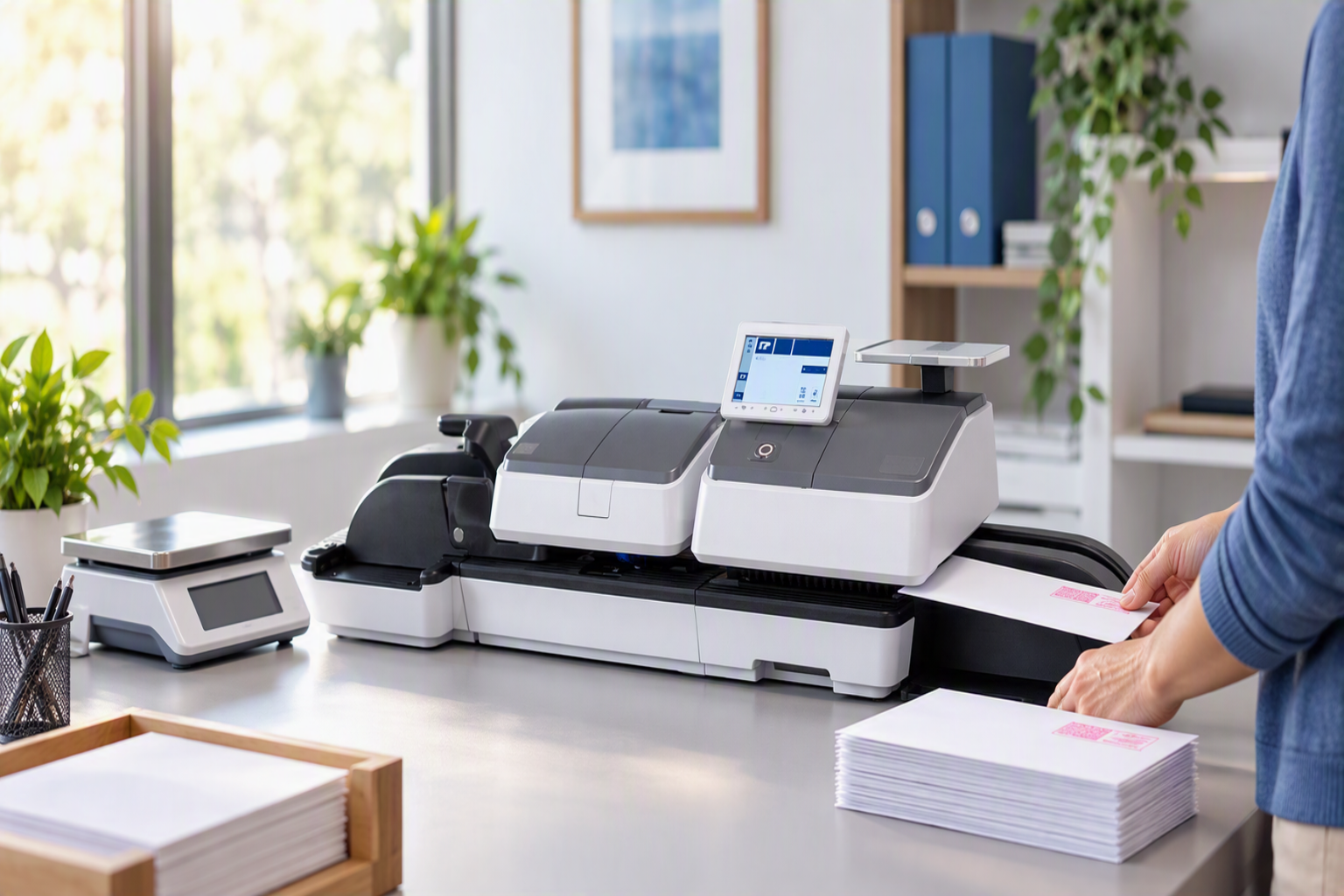
Are You Overpaying on Postage? A Plain-English Look at Mailing Systems
You probably don’t think about postage until the stamps run out. But if your office mails invoices, statements, or notices every week, postage is a steady cost that climbs every time the U.S. Postal Service raises prices, and it went up again on 2026-07-12. The good news: postage meter savings start the moment you stop buying stamps, and they are easy to measure.
The short answer: if your business mails more than a few dozen letters a week on stamps, you are likely paying more than you need to. The Postal Service charges less for metered mail than for stamped mail, and a mailing system also cuts the hidden costs of guessing weights and running to the post office.
What a postage meter actually does
A postage meter is a small machine, usually leased, that prints postage directly onto your envelopes or onto a label. You load funds into it, run your mail through, and it prints the exact amount each piece needs. Most mailing systems pair the meter with a built-in scale, so each letter or package is weighed and charged correctly instead of estimated.
Think of it as a stamp printer with a calculator attached. You pay only for the postage you print, and you can see exactly where it went.
How postage meter savings add up
Postage meter savings begin with a lower per-letter rate. Under the prices the U.S. Postal Service put into effect on 2026-07-12, a 1-ounce First-Class Forever stamp costs 82 cents, while a 1-ounce metered letter costs 78 cents, according to the USPS price announcement.
Four cents sounds small. Here is how it scales:
- 250 letters a month saves about $10 a month, or $120 a year.
- 1,000 letters a month saves about $40 a month, or $480 a year.
- 5,000 letters a month saves about $200 a month, or $2,400 a year.
Those numbers cover First-Class letters only. Metered mail can also qualify you for commercial pricing on packages and for presort discounts as your volume grows, which you can compare on the current USPS business postage prices page.
The savings that don’t show up on the rate chart
The rate difference is only part of the picture. A mailing system also trims costs you may not be tracking:
- No more guessing on weight. When staff aren’t sure, they add an extra stamp “just in case.” A scale ends that habit, and it also keeps short-paid mail from coming back.
- Fewer trips to the post office. Packages and odd-sized pieces can be weighed and paid for at your desk, so no one is standing in line on company time.
- Postage tracked by department. Most meters let you assign postage to an account code, so you can see which department or client drives mailing costs and bill it back if needed.
- A more professional envelope. Metered mail looks consistent, and many systems can print a return address or short message beside the postage.
This is the same thinking behind knowing your true cost per printed page: small per-piece costs are easy to ignore until you multiply them by a year.
When a postage meter isn’t worth it
We’ll be straight with you: a meter does not make sense for every office. A mailing system carries a monthly lease, and some models need ink or label supplies. If you mail only a handful of letters a week, the four-cent discount may never cover that monthly cost, and a roll of stamps is still the better deal.
The simple test is to compare your yearly postage savings, plus the staff time you get back, against the yearly cost of the equipment. If the savings win, a meter pays for itself. If they don’t, keep your stamps and revisit the question when your volume grows.
What to look for in a mailing system
The right mailing system matches your volume today with a little room to grow. A few questions help you narrow it down:
- How many pieces do you mail per day? Low-volume offices need a compact meter; higher volumes benefit from automatic feeding and sealing.
- Do you ship packages? A larger scale capacity keeps parcels in-house.
- Do you need cost tracking? Look for department or job accounting if you bill postage back to clients.
- Who updates the rates? Connected systems download new postal rates automatically, so a July price change doesn’t mean a service call.
- Who services it? A local technician gets a down meter running again faster than a mail-in repair.
You can compare meters, folder-inserters, and mail software on our corporate mailing systems page.
Duplicator Sales & Service has helped businesses across Kentucky and Southern Indiana manage their mail since 1959, and our Lexington office can run the numbers on your actual mail volume. If a meter won’t pay for itself, you’ll hear that from us too.
Frequently Asked Questions
How much do you save with a postage meter instead of stamps?
Under USPS prices effective 2026-07-12, a 1-ounce metered letter costs 78 cents and a 1-ounce Forever stamp costs 82 cents, so you save 4 cents per letter. At 1,000 letters a month, that is about $480 a year before counting staff time saved and fewer overpaid pieces.
Is a postage meter worth it for a small business?
It depends on your volume. A mailing system carries a monthly lease, so if you mail only a few letters a week, stamps are often cheaper. Once you mail several hundred pieces a month or ship packages regularly, the per-piece discount, accurate weighing, and fewer post office trips usually outweigh the lease cost.
Do postage meters update automatically when USPS raises prices?
Most current mailing systems connect to the internet and download new postal rates automatically when the Postal Service changes prices. Older standalone meters may need a manual update or a service visit, so it is worth asking how rate changes are handled before you sign a lease.
Does Duplicator Sales & Service help set up a mailing system?
Yes. Duplicator Sales & Service has served businesses across Kentucky and Southern Indiana since 1959, and our team sizes a mailing system to your real mail volume, installs it, trains your staff, and services it locally. Request a quote to see whether a postage meter fits how your team works.